

Original post here: Fair, affordable and climate-resilient housing: bridging energy and social policies – after event material – IEECP
Organisers: IEECP, ESCI, ICONS, Housing Europe, CPMR, ICLEI Europe, for the EU-funded projects HouseInc, Prolight, PREFIGURE, ReHousin, PowGen, EqualHouse, under the EU Sustainable Energy Days initiative.
How can citizen-informed policies deliver affordable & energy-efficient housing, protecting vulnerable groups? Panelists from various sectors reacted to testimonials from people impacted by housing inequalities.
Event recap
As Europe experiences increasingly extreme summer temperatures, the debate around how we live, consume energy, and manage our urban spaces has never been more critical. This pressing backdrop set the stage for our webinar, ‘Fair, affordable and climate-resilient housing: bridging energy and social policies‘, expertly moderated by PREFIGURE partner Kalina Tcolova from the Center for the Study of Democracy.
Local and regional authorities across Europe, covering cities, towns and rural areas are increasingly on the front line of climate adaptation, facing rising temperatures, extreme cold spells, and deepening housing affordability challenges. Vulnerable households and marginalised communities, such as low-income tenants, migrants, elderly residents and single-parent families, are disproportionately exposed to these risks – at home or working, yet policy responses often remain siloed within the energy, housing or social domains. The event was framed within the objectives of the European Affordable Housing Plan, which recognises affordability, energy efficiency and social inclusion as interconnected challenges. Building on this framework, the discussion shifts from strategy to implementation, examining how local and regional authorities can operationalise EU ambitions through locally-grounded, participatory policy design. A central feature of the session was an interactive policy exercise inspired by participatory foresight methods. Participants engaged with real citizens’ visions for affordable and climate-resilient housing and assessed their feasibility, the associated trade-offs, and the resulting policy implications.
Setting the policy challenge – Keynote from Malta
The event opened with a keynote from Matthew Zerafa (Housing Authority, Government of Malta and EU Housing Advisory Board). Zerafa noted that the fundamental definition of housing affordability has drastically evolved over the past decade. It is no longer just about the baseline cost to buy or rent a property; today, true affordability encompasses whether a household can comfortably afford its energy bills.
Across Europe, over 85 million people are currently at risk of housing exclusion or overburdened by costs, while deep renovation rates linger stubbornly below 1% annually. Highlighting Malta’s microcosm — characterised by the highest population density in Europe and significant demographic growth — Zerafa emphasized that green transitions must reinforce affordability rather than compounding financial pressures on citizens.
A core component of Malta’s strategy is its ongoing digital transformation, aiming to make the Housing Authority completely paperless by 2028. By introducing AI-enabled contract vetting and unified digital portal platforms, Malta successfully slashed rent subsidy application processing times from 69 days down to just 23 days in early 2026. ‘Digitalisation is not about technology for its own sake,’ Zerafa pointed out, ‘It is about delivering faster social justice to families when they need it most. Cutting red tape and lessening bureaucracy when it comes to funding is critical… I believe we should lessen bureaucracy at scale, because this is limiting us from tapping into funds and scaling up implementation. So what we’re left with is that our ideas are implemented, but are implemented solely on a pilot projects basis, which can be successful, but not at scale.’
Hearing from the ground – Citizens’ perspectives
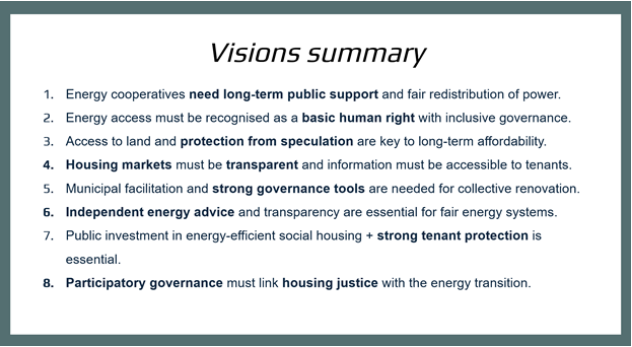
To contextualise the data, the session featured insights detailing firsthand accounts of housing vulnerabilities and inequalities directly from local citizens across Europe. The visions underscored the severe consequences of modern real estate pressures. In tourist-heavy destinations like Southern Spain, for example, a proliferation of holiday rentals has left many locals with virtually nowhere to live, prompting significant grassroots protests against short-term accommodation models. The visions were gathered by the PREFIGURE project, in the framework of touring across EU with a container, corner, a mobile laboratory that visited some of the project’s case study locations and asked citizens for their visions of the future of housing.
Panel discussion: mapping policy enablers and overcoming gaps
Following the citizen viewpoints, expert panelists weighed in on the delicate balance of creating climate-resilient structures without alienating vulnerable populations:
- Matthew Zerafa reacted on bridging energy and social policy : ‘For many years, housing, energy and social policy were developed largely in isolation. Today, Europe is increasingly recognising that their needs are interconnected. A housing policy that ignores energy efficiency risks increasing energy poverty […]. Housing is far more than just a shelter. Housing is the foundation upon which quality of life is built for today’s generation and for the generation of our children’
- Manon Burbidge (PhD Researcher, The University of Manchester) brought forward perspectives focused on energy vulnerability and marginalized groups in the UK. Burbidge identified persistent systemic underfunding and over a decade of austerity as key roadblocks to properly integrating migrants and vulnerable citizens into a stable housing ecosystem: ‘[…] there are several groups, including refugees and people seeking asylum, whose needs, practices and experiences in relation to housing and energy aren’t currently recognised within existing frameworks, which constitutes a form of recognitional injustice. So people aren’t represented, well represented or represented at all within energy and housing indicators, policies, political narratives, and are also underrepresented within decision making spaces […] the UK energy system can be very complicated when you’ve never dealt with […] when you’re new to a country, you might not speak the language, you’ve had a traumatic asylum journey, and suddenly you find yourself in a position where you have to navigate a privatised system. From the discussions and interviews that I did, it all seems to come back down to money and the lack of funding, especially in the UK context”.
- Apostol Dyankov (Head of Energy and Climate Department, Sofia Municipality) shared a fascinating contrast from the Bulgarian experience. While much of Europe moves toward market liberalisation, Bulgaria has maintained certain non-liberalised domestic energy frameworks precisely to preserve basic access. This sparked a compelling panel reflection on whether standard market models are sufficient when treating energy access as a core utility. ‘[…] energy access being recognised as a basic human right is very interesting for us because we still haven’t liberalised our energy markets based on the same assumption. So some European countries are now asking us whether they have done the wrong choice, or we have done the right choice […]. We think that it’s impossible basically… [for] homeowners [to] have effective participatory approach when it comes to renovation, renewables and any kind of like more ambitious project. But it turns out again and again that we are wrong. So people have a better participatory culture than we anticipate when we design these programmes and interventions […]. We have focused mostly on cooling in the winter and on energy poverty with regards to cooling. So now we find out that in 2024 we had like a big increase in the cooling days and I think this summer will be no different. So we have to wake up to the challenge and to realise that cooling demand is now solar energy poverty, which we didn’t have before.’
Interactive takeaways – Setting priorities for EU policymakers
Using an interactive Slido session, the webinar audience and speakers collectively voted on which citizen-informed visions should serve as primary policy recommendations to the European Commission:
1st place: Recognising energy access as a basic human right backed by inclusive governance frameworks. Panelists and audience members agreed that a human rights framework forces nations to adhere to structured legal obligations that safeguard public dignity.
2nd place: Massive public investment in energy-efficient social housing, running parallel to stringent tenant protections.
3rd place: Activating participatory governance to firmly link housing justice with broader urban and climate policies.
When asked what 30-second message they would deliver during a hypothetical “power walk” with EU Energy Commissioner Dan Jørgensen, the speakers agreed on a unified front:
There is no one-size-fits-all solution for Europe
Policies must adapt to national and municipal contexts, prioritizing systemic persistence and the needs of tomorrow’s generations over short-term market adjustments.
Stay tuned for further collaborative outputs as we continue building an affordable, green, and resilient housing future.
Event recording
https://www.youtube.com/watch?v=Jhn6alRR05k