

Christiania, 8 June
By the Malmö University (MAU) team
The EU-funded research project PREFIGURE investigates how groundbreaking housing and energy renovation initiatives throughout Europe can show the way to a green transition that is fair and democratic. Successful examples from Great Britain, Germany, Netherlands, Greece, Spain, Bulgaria demonstrate how the transition to the use of sustainable energy sources to heat up homes can take place in a way that really includes local inhabitants in the decision-making process and that keeps renovation costs affordable.
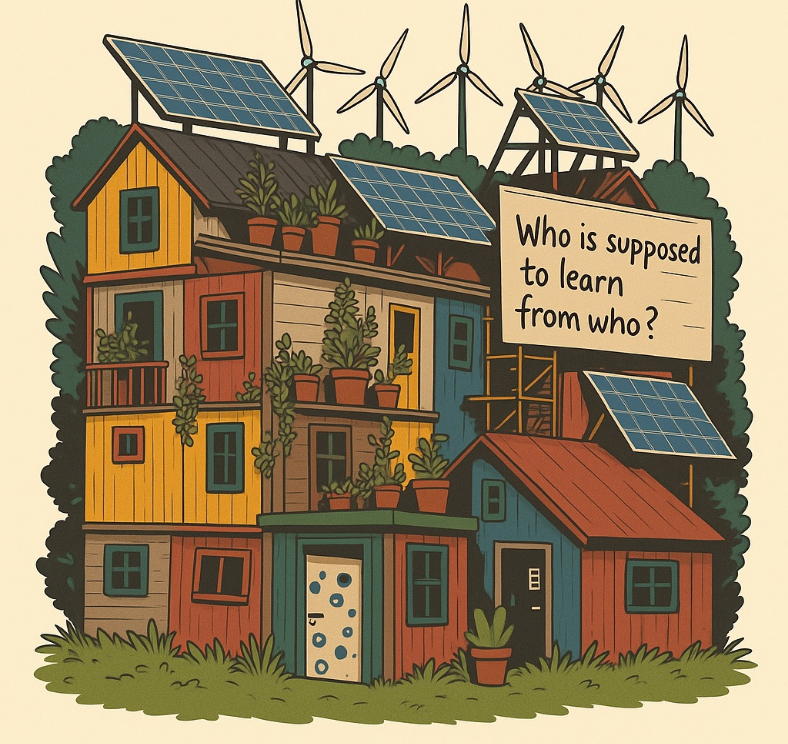
In Denmark, we look at two initiatives Europe can learn a lot from. One is the energy and housing renovation efforts that are under way in the Free Town of Christiania in the heart of Copenhagen. Over the past years, Christiania has made a major move from individual heating solutions for homes to a sustained effort to find climate-friendly heating solutions. Small do-it-yourself district heating systems have been installed, solar panels are being put on roofs, and plans for a major geothermal heating system in the centre of Christiania are underway, all with respect for the sensitive architectural heritage of the former military buildings. Now that Pusher Street has been closed, Christiania is rebranding itself as a frontrunner for a green and democratic energy transition. But the largest hindrance to this effort remains the financing of it all.
The other leading Danish example of an inclusive and fair green energy transition is the attempt of Allmene Boliger to use the roofs of their huge housing stock to install solar panels to become self-sufficient in electricity supply. The approximately 2,000 hectares of unused roof surfaces in the non-profit building stock entails an obvious opportunity for solar energy. If only a quarter of the area were to be covered with solar cells, it would increase the capacity of solar energy by 0.5 GW, corresponding to 39 % of the total solar energy capacity in Denmark in 2021. They would be capable of producing 1GW or the equivalent of Denmark’s two largest offshore windmill facilities. Although they could make a major contribution to the green energy transition, Allmene Boliger’s biggest concern right now remains legal restrictions that prevent them from transmitting self-generated green electricity between residential buildings.
Both cases will be presented at the travelling corner exhibition between 11 and 13 June, every day from 11am to 6pm. After Thessaloniki, Sofia, Barcelona and Amsterdam, the exhibition has arrived in Copenhagen and will take place on Christiania grounds (next to the Grey Hall). On day one, there will be a series of short presentations from Christiania residents and local actors about ongoing developments in energy infrastructure, the housing energy renovation scheme, the implementation of the Christiania energy masterplan & the upcoming renovation of the Grey Hall, transformation of the Pusher Street, as well as the development of new non‑profit housing units in Christiania. On day two, the highlight will be a hands‑on session of window restauration led by local expert Anna Tengberg. Anna will show how craftsmanship and reuse can preserve both aesthetics and functionality and why repair matters in a world of rapid replacement. This will be followed by a public guided tour about behind-the-scenes energy and waste management infrastructures in Christiania. The final day will end with a public roundtable about energy communities in Denmark and the Netherlands. Throughout the days, we will engage with the passing-by public and talk with them about their energy life stories.
© made by Edgar Sarmulis with AI