

CHRISTIANIA
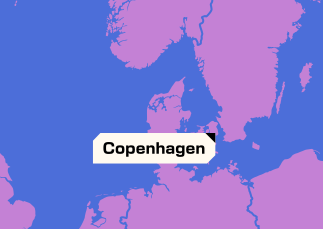
Christiania is an autonomous neighbourhood in central Copenhagen that was founded in 1971 by activists and artists. It operates on the principles of collective land ownership, affordability, and self-governance. Housing is not treated as a commodity, with user fees set well below local rent averages. Funding is provided for communal needs, which are maintained by the residents themselves. Since 2001, the Nabovarme project has introduced renewable energy solutions, transforming the heating system into one powered by wood pellets and operated collectively. By combining renewable energy, DIY practices, and collective strategies, Christiania offers an innovative, community-driven model for addressing the housing–energy nexus.


KEY
CHALLENGES
Ageing housing stock, costly retrofitting, deliberative democracy slows decisions

MAIN
IMPACT
Democratic green transition with DYI, reuse and sufficiency practices

UPSCALING
POTENTIAL
Decentralised replication, network of experimental zones

ACTORS
Initiators and current actors
- Citizen groups/communities: energy groups and the wider community can be directly involved in decision-making.
- Institutional: Copenhagen Municipality. Christiania Fund.
- Market: Nordløv and Kuben (both energy consultants).
Beneficiaries
- Residents of Christiania will improve the quality of their housing and well-being in the long term, while reducing costs.
- Municipalities and national bodies will meet decarbonisation targets.
- Other communities can learn from and tap into Christiania’s knowledge, such as co-housing projects and alternative housing models.
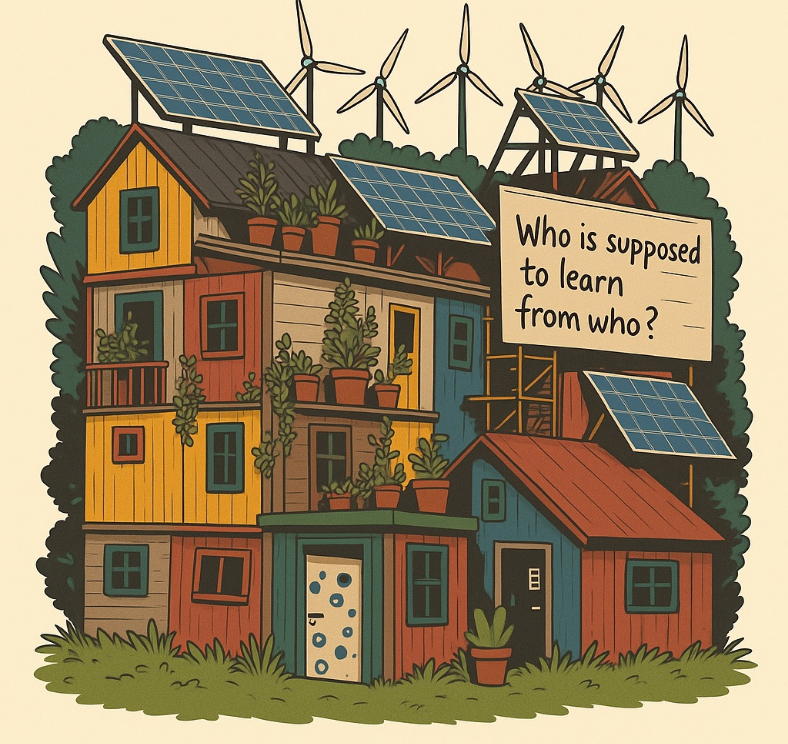
Created by Edgar Sarmulis with the use of A.I.
CHALLENGES
- Christiania’s housing stock and population are ageing. Retrofitting would be beneficial but costly, creating tension with the community’s goal of providing affordable housing for vulnerable groups, such as former drug addicts.
- As an autonomous area in central Copenhagen, Christiania relies on direct, and consensus-based democracy, and residents often build, maintain, or renovate their own homes. This makes retrofitting challenging, as it requires greater resources and technical expertise.
INNOVATION
Christiania’s ongoing development shows how the green transition can be democratic and fair while maintaining housing affordability. Its consensus-based democracy and DIY practices, which focus on reuse, repair, and sufficiency, show how technocratic, top-down approaches can be complemented or replaced by prefigurative practices.
Blocking factors
- Financial: financial resources are limited, particularly following the closure of Pusher Street. While subsidies and funding opportunities exist, the community seeks to maintain its autonomy and continue serving low-income residents. This makes achieving the labour- and capital-intensive transition a delicate balancing act.
- Internal governance: the neighbourhood’s direct democracy model requires a consensus for decision-making. This deliberative process is often slow, and some residents remain wary of involving external actors such as municipal authorities, energy consultants, or planners.
Facilitating factors
- Legal and institutional: ambiguity and flexibility at both national and municipal levels enable experimentation and innovation. Formal ownership and local autonomy support governance, and access to external funding enables energy renovations.
- Policy and cultural context: strong sustainability ambitions, a tradition of non-profit housing and energy provision, and local practices in DIY, repair, and reuse create favourable conditions for innovative, community-led infrastructure.
IMPACTS
Community Impact
This innovation enhances the well-being of low-income and vulnerable populations by ensuring they have long-term access to higher-quality housing and more affordable energy. Furthermore, it serves as a valuable case study for the organisation and management of complex socio-technical transitions, while also shedding light on the significant challenges and limitations that these processes entail.
Policy Impact
The innovation demonstrates the importance of experimental zones in accelerating the green transition. It also emphasises the importance of legal and institutional flexibility, and the creation of alternative pathways, in facilitating this transition.
UPSCALING
POTENTIAL
The models for energy, housing, and community governance in Christiania could potentially be scaled up through the decentralised replication and networks of experimental zones, which would preserve the flexibility and adaptability of the grassroots approach rather than leading to rigid institutionalisation.
EXPLORE ALL
PREFIGURE’s ‘Prototypes of Change‘ showcase 16 innovative, real-life responses to energy-housing precarity in the form of social, political, and economic solutions across eight countries: Bulgaria, Denmark, Estonia, Germany, Greece, Spain, Sweden and the Netherlands.