

Reviu
Launched in Barcelona in 2024, Reviu is an online platform created by IDRA to address the lack of equity and transparency in Spain’s rental market by incorporating tenants’ perspectives. It facilitates the exchange of reviews from tenants about the quality of rental flats, landlords, and real estate agents, thereby functioning as both a technological innovation and a communal practice. Reviews cover important topics such as the quality of the property, thermal comfort, whether the rent is fair, how well the landlord communicates, and the surrounding community and area. Alongside user-generated reviews, the platform offers practical resources such as advice and general data on renting a home. By combining transparency, shared experiences, and accessible information, Reviu has the potential to foster a collaborative tenant community while promoting accountability in the rental sector.


KEY
CHALLENGES
Rental market inequity, sustaining user engagement, polarised reviews

MAIN
IMPACT
Open-source tenant review platform promoting accountability

UPSCALING
POTENTIAL
Replication via opensource model with municipal support

ACTORS
Initiators
- Citizen groups/communities: tenant communities and citizen organisations in Catalonia have the potential to drive and advocate for the replication and expansion of the project.
- Institutional: Municipality of Barcelona (potential future collaborator, pending a decision).
- Market: existing real estate platforms in Spain (they provide the contrasting market context that Reviu addresses).
- NGOs/research institutes: IDRA Barcelona Urban Research Institute (an urban research and innovation cooperative that fosters social and ecological justice).
Current actors
- Institutional: Ateneu d’Innovació Digital i Democràtica (Barcelona City Council)
- Market: Sinapsys
- NGOs/Research Institutes: IDRA Barcelona Urban Research Institute.
Beneficiaries
- Tenants in private rental housing (greater transparency, fairer rents and improved housing and energy conditions).
- Vulnerable groups (e.g., migrants and female-headed households) are protected from discriminatory landlord practices.
- Landlords and real estate agents are incentivised to improve property quality and energy efficiency.
- Municipalities and housing advocates can access tenant-generated data to inform housing policy and regulation.
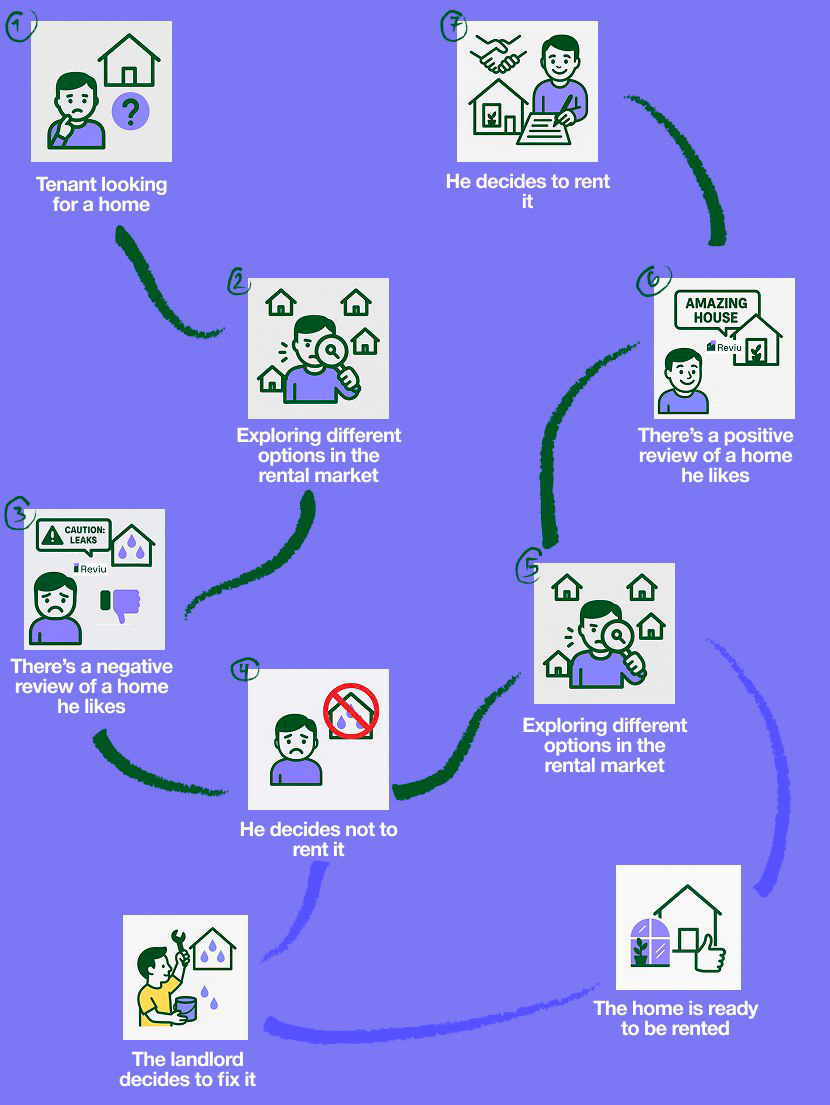
Created by the IDRA team with the use of Canva
CHALLENGES
There is a persistent asymmetry in Spain’s private rental market, where speculative practices, discriminatory treatment, and rent inflation particularly affect vulnerable groups such as migrants and female-headed households. Furthermore, sustaining tenant engagement and generating reliable review data pose significant challenges, as polarised participation limits the platform’s ability to promote transparency regarding housing quality and energy efficiency.
INNOVATION
An open-source digital platform for tenant reviews, knowledge-sharing and accountability practices.
Blocking factors
- Institutional: limited financial stability and a lack of municipal integration constrain Reviu’s ability to grow beyond Barcelona, since the platform relies on ad-hoc support rather than stable institutional backing.
- Internal governance: user participation remains polarised, with reviews concentrated around extreme experiences. This undermines the platform’s capacity to generate reliable, representative data on housing quality and energy efficiency.
Facilitating factors
- Institutional: Barcelona’s active housing policy landscape and potential municipal collaboration, and the open-source design that enables replication without proprietary constraints.
- Social/cultural: strong tenant advocacy networks and civic organisations in Catalonia, and a rising tenant population seeking affordable and transparent rental options.
IMPACTS
Community Impact
- Social: empowers tenants by amplifying their voices, fostering the exchange of knowledge, and challenging discriminatory landlord practices.
- Housing/Energy: improves transparency on rental costs, housing quality, and energy efficiency, incentivising landlords to improve thermal comfort and sustainability.
- Political: strengthens tenant advocacy and accountability mechanisms by providing data that can inform fair housing policies and municipal regulations.
Policy Impact
The initiative highlights the importance of integrating tenant-generated data into housing policy in order counter speculative practices and enhance accountability within Catalonia’s rental market.
UPSCALING
POTENTIAL
For upscaling Reviu, financial instability and low user engagement must be overcome, while the platform’s open-source design and strong tenant networks must be leveraged. Institutional support, particularly from municipalities, could enable the model to be replicated across Catalonia and potentially the wider EU rental market.
EXPLORE ALL
PREFIGURE’s ‘Prototypes of Change‘ showcase 16 innovative, real-life responses to energy-housing precarity in the form of social, political, and economic solutions across eight countries: Bulgaria, Denmark, Estonia, Germany, Greece, Spain, Sweden and the Netherlands.