

CommonEn
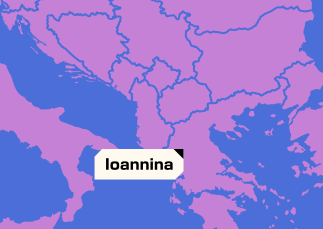
CommonEn, an energy cooperative established in Ioannina, Greece, in 2021, launched its first solar park in 2023. This initiative has the capacity to provide electricity to 35 households and local small-to-medium enterprises (SMEs). Backed by the Electra Energy, CommonEn is committed to promoting sustainable energy and tackling energy poverty. Operating in a region characterised by high unemployment and an ageing population, CommonEn is a prime example of a grassroots social innovation in the field of community-centred energy solutions.


KEY
CHALLENGES
Energy poverty, old housing, unstable funding & legal complexity

MAIN
IMPACT
Non-profit cooperative with solidarity-based governance

UPSCALING
POTENTIAL
Accessible lending tools & subsidies to include lowincome households

ACTORS
Initiators
- Citizen groups/communities: the project was founded by local citizens. It was supported by Electra Energy, an organisation that promotes energy communities in Greece and southern Europe
Current actors
- Institutional: CommonEn cooperative, support and collaboration with local/regional authorities, and Electra Energy.
- Market: there is no direct market actor involvement as the initiative is explicitly non-profit and non-market oriented.
- Other organisations: P2P Lab, Tzoumakers, and other local alternative and solidarity organisations.
Beneficiaries
Local households and SMEs in Epirus participating in the cooperative, especially those facing energy poverty, as well as vulnerable and low-income groups, are included through targeted support.
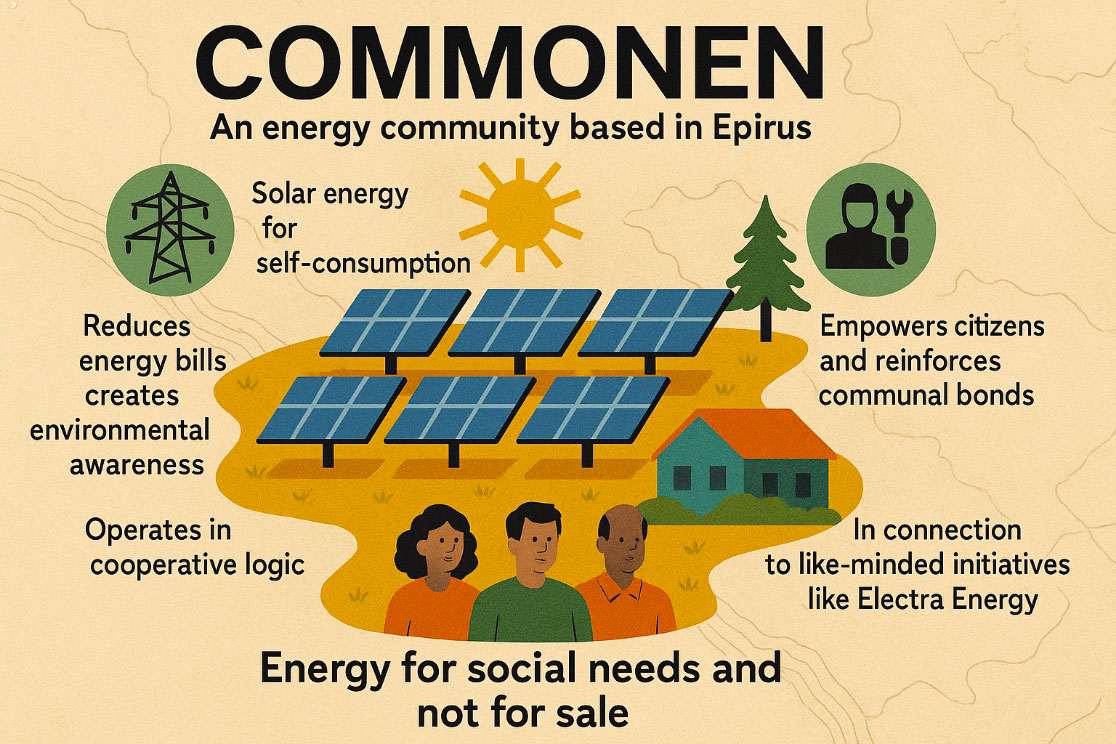
Created by the ICL team with the use of A.I.
CHALLENGES
- Old, poorly insulated housing that is costly-to-heat, especially impacting vulnerable groups.
- High rates of energy poverty and expensive energy for households.
INNOVATION
Management: a non-profit cooperative model with democratic, ‘one member-one vote’ governance, and the targeted inclusion of vulnerable groups. It is based on solidarity and a non-commercial ethos, and is developing new ways to enable low-income participation.
Blocking factors
- Financial: limited access to stable funding and capital excludes the poorest from participation.
- Institutional: complex and frequently changing legal frameworks, bureaucratic delays, and a lack of legal expertise among community members.
Facilitating factors
The prototype is supported by strong local networks, community solidarity, and grassroots activism and organisations such as Electra Energy. The adoption of new legal frameworks in 2018 and 2023 was crucial in enabling the establishment of CommonEn.
IMPACTS
Community Impact
CommonEn has enabled dozens of local households and SMEs to access affordable and renewable energy through collective self-consumption. This has directly reduced energy costs and addressed energy poverty. The cooperative has fostered community solidarity and inclusion by supporting vulnerable groups and encouraging democratic participation in the energy transition from the ground up.
Policy Impact
Energy and housing policies must be integrated with supportive legal frameworks and simplified procedures to enable energy communities to effectively address both energy poverty and housing needs.
UPSCALING
POTENTIAL
Create accessible lending tools or public subsidies to enable more low-income and working-class households to join energy cooperatives. This will ensure a wider social impact and enable larger-scale, inclusive community energy projects in Greece.
EXPLORE ALL
PREFIGURE’s ‘Prototypes of Change‘ showcase 16 innovative, real-life responses to energy-housing precarity in the form of social, political, and economic solutions across eight countries: Bulgaria, Denmark, Estonia, Germany, Greece, Spain, Sweden and the Netherlands.