

REFUGEE SQUATS AND SELF-HOUSING
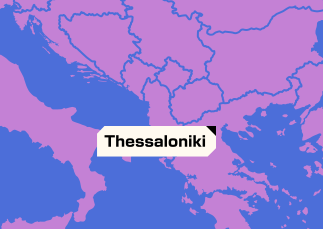
PREFIGURE analyses institutional and collective actions and solidarity initiatives that address the energy poverty and substandard housing conditions experienced by refugees in both state-run reception centres and in self-housing or squats in Greece. In both types of accommodation, refugees experience very poor energy standards, either living in container boxes in welcoming centres or in substandard housing in underprivileged neighbourhoods, mostly classified in a low energy class. These poor energy standards incur high energy costs that refugees struggle to cover.

KEY
CHALLENGES
Substandard housing & unsafe energy practices; exclusion from energy transitions

MAIN
IMPACT
Solidarity-based selfgovernance, repair culture, shared energy practices

UPSCALING
POTENTIAL
EU policy harmonization, collaboration with solidarity groups, renewable projects in unused Spaces

ACTORS
Initiators
- Citizen groups/communities: refugees in squats (managing their own energy needs); residents promoting housing and energy solidarity (e.g., Ano Poli, Thessaloniki).
- Institutional: the Greek Ministry of Migration and Asylum; the National Energy and Climate Plan authorities.
- Market: Architecture and engineering firms involved in camp design and construction.
Current actors
- Citizen groups/communities: residents of wall houses around Ano Poli, Thessaloniki.
- Institutional: Greek Ministry of Migration and Asylum; Major Development Agency; Thessaloniki local government technical partner; and Aristotle University of Thessaloniki.
- NGOs/research institutes: Casa base, a community centre.
Beneficiaries
Refugees, local communities, and the state-run accommodation system for refugees and asylum seekers.
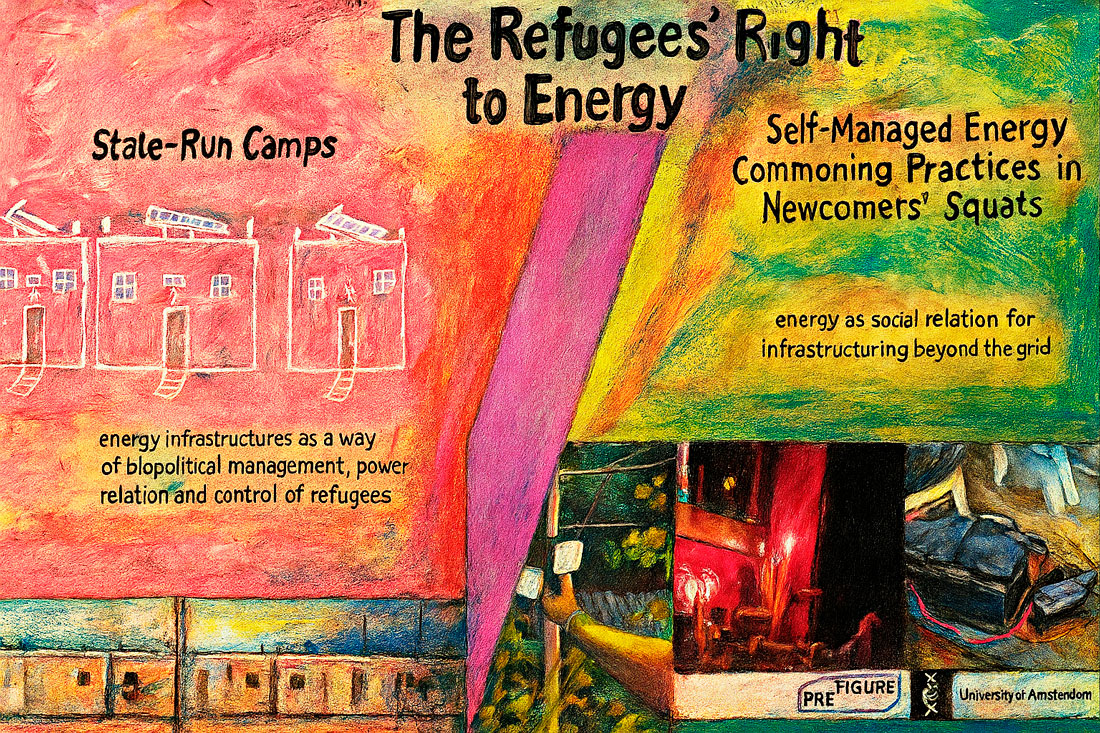
Created by Ch Tsavdaroglou with the use of A.I.
CHALLENGES
- Refugee living in self-built or squatted accommodation experience in substandard housing and energy conditions. They are unable to meet their energy needs safely and sustainably. They resort to making innovative, but often unsafe, connections to the energy supply.
- Those in state-run reception centres also live in substandard housing and energy conditions, and are not involved in discussions about energy transitions.
INNOVATION
In the context of refugee self-housing, innovative forms of energy commons practices and shared energy connections highlight the housing-energy nexus as a social relationship that fluctuates between acts of solidarity and means of oppression.
Blocking factors
In state-run reception centres:
- Financial: lack of state funding for energy upgrades and, often, lack of funding to meet basic cooling needs in the summer.
- Techno-social: although state-run centres are equipped with ‘high-tech’ surveillance technologies, their energy and housing needs are met by very basic ‘low-tech’ infrastructure.
In refugee self-housing:
- Financial: the energy supply is almost a ‘luxury’ for highly marginalised and precarious populations, who often have to choose between buying food or heating their homes.
Facilitating factors
- For state reception centres: the state ownership of land and infrastructure can greatly support potential energy upgrades in camps. PREFIGURE prompted national interest – refugee-led initiatives provide opportunities for progress.
- For self-housing: community-driven solidarity, especially in occupied houses, fosters mutual support, self-organisation, and culturally rooted alternative energy practices.
IMPACTS
Community Impact
Self-housing: socially and communally shared energy provision. These practices are self-governed and small-scale, which makes it easier to resolve tensions. Dilapidated buildings and infrastructure are repaired, and the maintenance and repair expertise of refugee populations is shared in housing and energy-sharing practices.
Policy Impact
It is imperative to harmonise refugee centres with EU energy transition targets, given the large populations they host. Currently, there are no clear guidelines on energy transitions, housing standards, or the management of energy resources in an environmentally friendly and participatory way in state-run reception centres across the EU.
UPSCALING
POTENTIAL
- A harmonised EU policy on energy-saving and eco-friendly solutions could improve living conditions for refugees.
- Unused spaces could be used for solar or wind energy projects, and planting gardens and trees would improve the environment and enhance energy efficiency.
- Collaboration between the state, solidarity groups and energy communities could provide squatters with sustainable energy technologies and expertise.
EXPLORE ALL
PREFIGURE’s ‘Prototypes of Change‘ showcase 16 innovative, real-life responses to energy-housing precarity in the form of social, political, and economic solutions across eight countries: Bulgaria, Denmark, Estonia, Germany, Greece, Spain, Sweden and the Netherlands.