

BRIXTON ENERGY
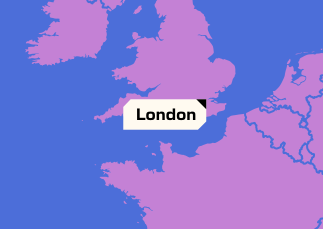
Brixton Energy is a citizen-led cooperative based in South London, is an organisation that promotes clean, renewable energy sources while ensuring tangible benefits for the local community. Through active community engagement, shareholder participation, and the creation of green jobs, Brixton Energy reinvests its profits in a Community Energy Efficiency Fund (CEEF) to increase its impact. As a community-owned cooperative, Brixton Energy collaborates with the local borough administration, which provides financial and institutional support to foster sustainable, community-centred energy solutions.


KEY
CHALLENGES
Poor quality housing stock, limited solar revenue, complex regulation

MAIN
IMPACT
UK's first urban community-owned solar cooperative

UPSCALING
POTENTIAL
Upscaled via Repowering London & policy influence

ACTORS
Initiators
- Citizen groups/communities: members of the Brixton Energy Cooperative.
- Institutional: Lambeth Council and social housing providers.
Current actors
- Citizen groups/communities: members of the Brixton Energy Cooperative. They are responsible for installing and running of the energy solutions.
Beneficiaries
The primary beneficiaries are low-income residents and social housing tenants, who benefit from lower energy costs, training opportunities, and improved housing efficiency. The broader local community also benefits from environmental education and increased energy awareness.
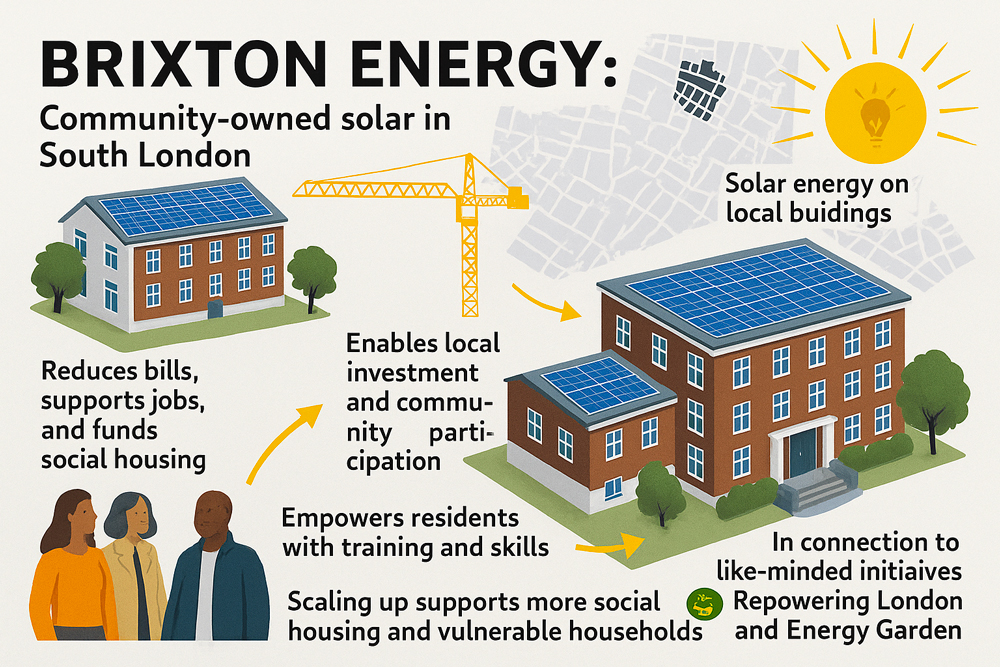
Created by the ICL team with the use of A.I
CHALLENGES
The poor quality of social housing is evident in issues such as damp, inadequate insulation, and inefficient heating systems. This is exacerbated by the unaffordability of housing caused by gentrification and deregulated property regimes, which displace low-income residents.
INNOVATION
Financial: Brixton Energy pioneered the UK’s first urban community-owned solar energy cooperative, enabling social tenants to invest in local renewable energy projects. This model generates clean power and provides the community with economic benefits.
Blocking factors
- Financial: low revenue from solar projects (e.g. £500 per year for community benefits) restricts the cooperative’s ability to grow and have a significant local impact.
- Institutional: complex regulatory frameworks and the requirement for energy supply licenses limit cooperatives’ ability to distribute energy directly.
Facilitating factors
Innovation in the governance model that enabled community members to invest in Brixton Energy. In addition, the organisation’s initial set-up was made possible through local and national grants, as well as support from the Lambeth Council.
IMPACTS
Community Impact
Brixton Energy has empowered residents by enabling them to invest in community-owned solar projects and benefit from reduced energy bills, thereby addressing fuel poverty. The initiative has also fostered community cohesion by providing training and educational workshops on renewable energy and sustainability practices, as well as encouraging hands-on participation.
Policy Impact
Brixton Energy has demonstrated the viability of community-led renewable energy projects, influencing policy discussions on community energy and inspiring subsequent initiatives, like Repowering London. Its success has contributed to local energy and climate action plans that prioritise equitable energy access and sustainability.
UPSCALING
POTENTIAL
The project has already led to innovations in the governance and financing of energy communities being scaled up through initiatives such as Repowering London, which are driving policy revisions at the local, national, and international levels. The key point to note is that the members and founders of Brixton Energy are also involved in these other initiatives, enabling the sharing of knowledge and expertise.
EXPLORE ALL
PREFIGURE’s ‘Prototypes of Change‘ showcase 16 innovative, real-life responses to energy-housing precarity in the form of social, political, and economic solutions across eight countries: Bulgaria, Denmark, Estonia, Germany, Greece, Spain, Sweden and the Netherlands.