

HOUSING THESSALONIKI
Housing Thessaloniki addresses the issues of housing crisis and energy poverty by renovating vacant and underused properties to create safe, affordable and energy-efficient social housing for low-income households. This multi-scalar approach, which involves state, municipal and local development agencies, offers a sustainable alternative to the conventional housing market by addressing both immediate and long-term housing and energy insecurity.


KEY
CHALLENGES
Financialisation, gentrification, slow bureaucracy

MAIN
IMPACT
Reuse & retrofit of vacant housing; municipal-led affordability

UPSCALING
POTENTIAL
Pilot for national vacant property reuse programme

ACTORS
Initiators
- Institutional: Municipality of Thessaloniki; Major Development Agency of Thessaloniki (MDAT); CO-SPACE research team; Department of Spatial Planning & Development Engineering; Aristotle University of Thessalonikki; Ministry of Social Cohesion and Family.
Current actors
- Institutional: Ministry of Social Cohesion and Family; Municipality of Thessaloniki; MDAT;
Beneficiaries
Vulnerable groups, low-income residents, and migrant communities.
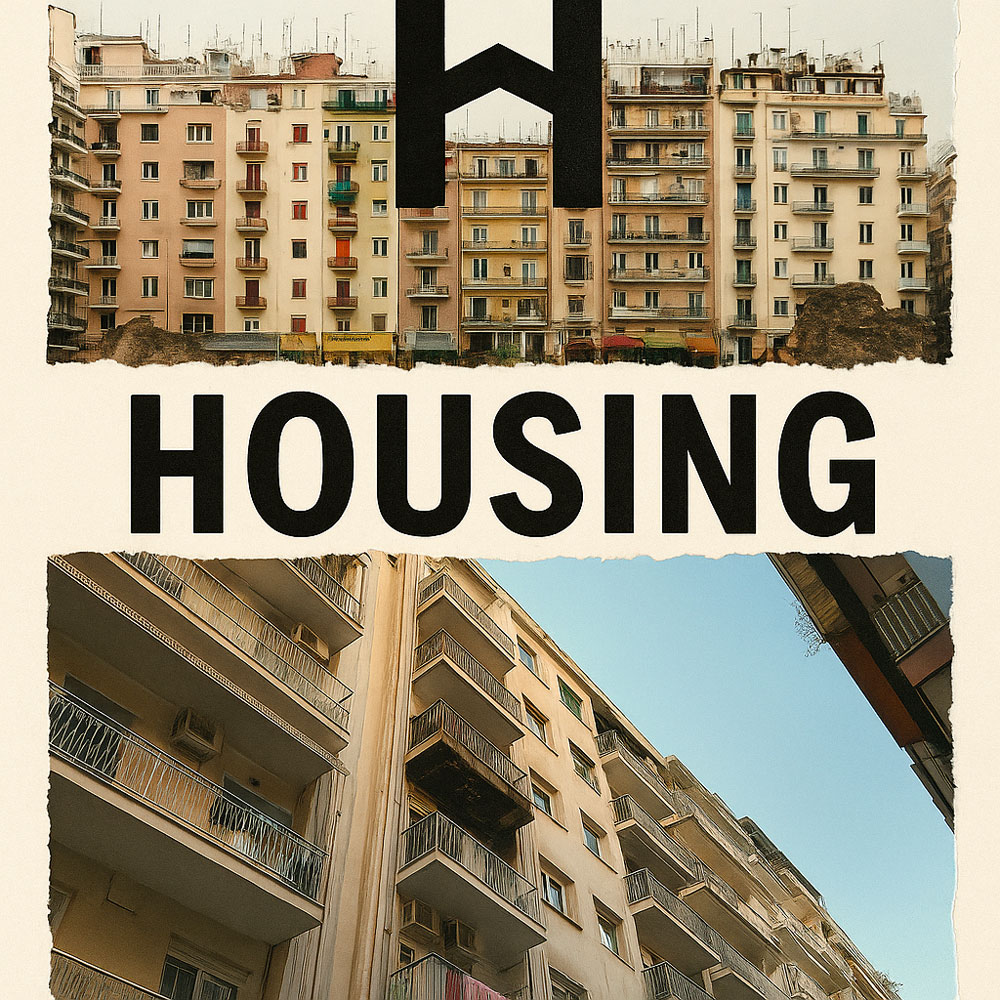
Created by the KIT team with the use of A.I.
CHALLENGES
Rising housing costs driven by financialisation, gentrification and the touristification of major cities. A slow, complex, centralised bureaucracy impedes housing and energy justice. The centralised policy system limits the ability of local governments to act decisively and effectively.
INNOVATION
Reuse and energy upgrade of vacant properties. This is the only public housing initiative currently available in the city. It focuses on both affordability and energy efficiency. It avoids free market involvement. Properties come from both public and private sources. It promotes a multilevel governance model for social housing.
Blocking factors
- Institutional: bureaucratic complexity and systemic delays in fund disbursement.
- Techno-social: lack of technical expertise among local construction professionals; use of suboptimal materials and unsustainable technologies.
- Financial: lack of structural funding to scale up and ensure long-term viability of the project.
Facilitating factors
- Social: emerging social movements and cooperatives in Thessaloniki advocate for housing rights and support resident-led energy initiatives, fostering community engagement.
- Institutional: the recent re-establishment of a national housing authority that centralises housing policy coordination. Municipal involvement allocates public resources to reclaim and retrofit vacant properties.
IMPACTS
Community Impact
- Provides affordable housing with municipal involvement
- Provides energy-efficient flats to vulnerable groups
Policy Impact
Demonstrates how local governance can effectively manage building stock and develop housing policy pathways through multi-level collaboration between municipal and national authorities, while empowering local public sector administration and oversight.
UPSCALING
POTENTIAL
Can act as a pilot for a national programme to reuse and upgrade public and privately owned vacant properties for social rental, under public sector supervision, to address both housing and energy challenges.
EXPLORE ALL
PREFIGURE’s ‘Prototypes of Change‘ showcase 16 innovative, real-life responses to energy-housing precarity in the form of social, political, and economic solutions across eight countries: Bulgaria, Denmark, Estonia, Germany, Greece, Spain, Sweden and the Netherlands.