

Wikihousing
WikiHousing is a participatory initiative in Barcelona that delivers affordable, sustainable public housing through co-design and community involvement. Founded by architects David Baró and David Juárez, the initiative addresses the issue of housing affordability. The project uses lightweight balloon frame construction and modular design, offering an innovative solution to the challenges posed by land, housing and energy availability in the city. Its goal is to empower residents to co-create and manage their homes. In this way, WikiHousing combines technological innovation with participatory governance to promote community-led urban design.


KEY
CHALLENGES
Affordability crisis, bureaucracy, rigid tender laws

MAIN
IMPACT
Participatory housing with modular sustainable construction

UPSCALING
POTENTIAL
Open-source participatory housing; EU& municipal backing needed

ACTORS
Initiators
- Citizen groups/communities: future residents (including inner-city tenants, undocumented migrants, women and young people) who are engaged in co-design, construction and self-management.
- Institutional: BIT Habitat Foundation (a city innovation foundation that awarded Wikihousing the project site through a competition)
- NGOs/research institutes: David Baro & David Juarez (architects, co-initiators of the prototype), Straddle 3 (cooperative of architects), Sociedad Orgánica (Cooperative of sustainable building) and IDRA Barcelona Urban Research Institute (an urban research and innovation cooperative that fosters social and ecological justice).
Current actors
- Citizen groups / communities: depending on the building.
- Institutional: Barcelona City Council.
- NGOs/Research Institutes: Straddle 3, Sociedad Orgánica and IDRA Barcelona Urban Research Institute.
Beneficiaries
- Future residents and tenants of public housing
- Vulnerable groups in inner-city Barcelona, who will gain access to safe and participatory housing
- Municipal and local housing authorities, who will benefit from a transferable blueprint for sustainable, cost-effective public housing solutions
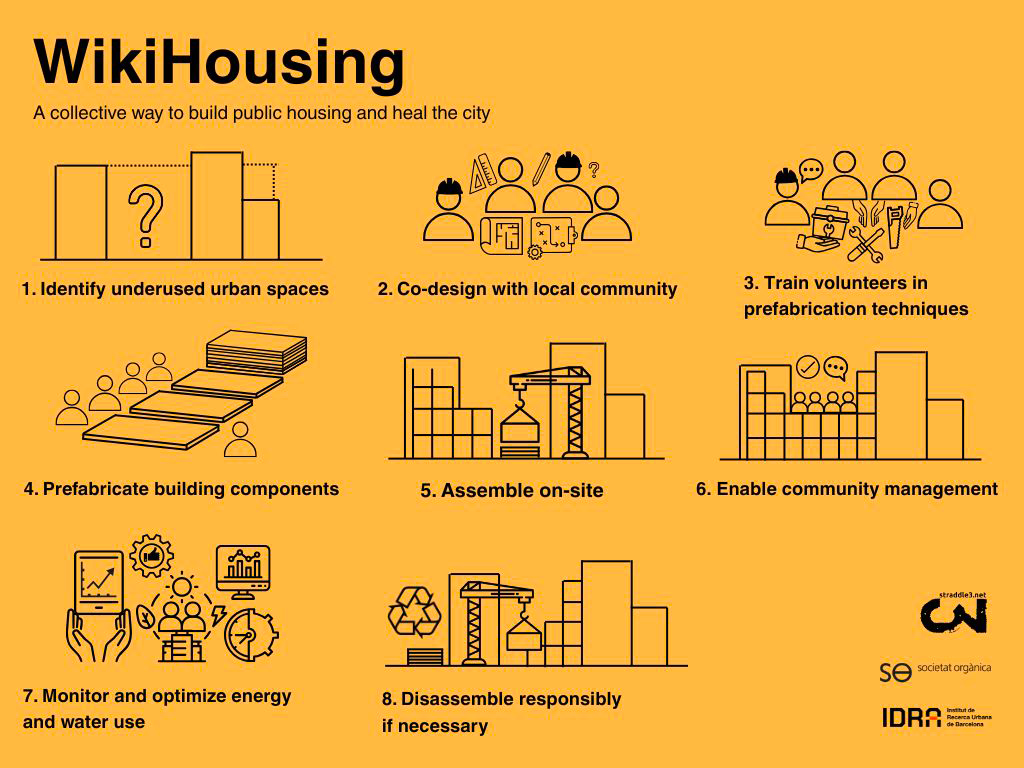
Created by the IDRA team with the use of Canva
CHALLENGES
Key challenges include the high pressure on housing affordability in Barcelona’s inner city, where vulnerable groups face limited access to safe, energy-efficient homes. Furthermore, providing publicly protected housing at below-market prices while ensuring collective participation, high-quality construction and energy efficiency is complicated by bureaucracy and rigid national tender laws.
INNOVATION
A participatory housing model that combines technological innovation in sustainable construction materials and modular design with collective governance practices. This enables future residents to co-design, self-build and manage their homes collaboratively.
Blocking factors
- Financial/techno-social: inconsistent funding streams and reliance on non-standardised, tailor-made solutions hinder industrial scalability and replication in different urban contexts.
- Institutional: bureaucratic complexities and rigid national tender laws constrain the integration of participatory deisng and modula construction, limiting the prototype’s scalability.
Facilitating factors
- Institutional: support from the BIT Habitat Foundation and access to municipal land; emerging EU-level housing policy to enhance funding opportunities.
- Social/cultural: the active participation of future residents in co-design and self-build processes; the growing awareness of, and demand for, affordable, sustainable and energy-efficient housing solutions in Barcelona.
IMPACTS
Community Impact
- Social: empowers future residents by engaging them in co-design, self-building and collective management, thereby fostering skills development and social inclusion.
- Housing/energy: provides affordable, energy-efficient and high-quality housing, thereby reducing greenhouse gas emissions and improving thermal comfort.
- Political: cemonstrates a scalable, participatory public housing model to inform municipal housing strategies and resist low-carbon gentrification.
Policy Impact
The initiative highlights the potential of participatory, energy-efficient public housing to inform urban housing policy. It demonstrates how collaborative design and modular construction can accelerate delivery while ensuring affordability and social inclusion.
UPSCALING
POTENTIAL
Scaling up WikiHousing depends on overcoming bureaucratic and funding barriers while leveraging its open-source, participatory construction model. Strong institutional support, including collaboration at municipal and EU levels, could enable replication across Barcelona and other European cities facing affordable housing and energy efficiency challenges.
EXPLORE ALL
PREFIGURE’s ‘Prototypes of Change‘ showcase 16 innovative, real-life responses to energy-housing precarity in the form of social, political, and economic solutions across eight countries: Bulgaria, Denmark, Estonia, Germany, Greece, Spain, Sweden and the Netherlands.