

Non Profit Housing Associations
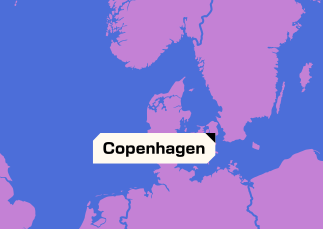
Denmark’s non-profit housing associations (NPHAs, or Almene Boliger in Danish) provide affordable, democratically managed housing for around 20% of the population, including vulnerable groups. They are supported by state subsidies and municipal oversight. The sector is governed by tenant-elected boards and coordinated by the umbrella organisation BL. It also promotes energy initiatives, as demonstrated by the Øbro95 housing association in Copenhagen, where residents use solar panels, batteries, and spot-price billing with support from the green technology firm Enyday. While this model highlights the potential for tenant-led, affordable and sustainable energy transitions, concerns have been raised about its replicability in disadvantaged areas due to persistent financial and structural barriers.


KEY
CHALLENGES
Commodification policies, scaling green retrofits in disadvantaged estates

MAIN
IMPACT
Tenant democracy with energy optimisation (solar, batteries)

UPSCALING
POTENTIAL
Replication in EU social housing; hindered by
restrictive legislation

ACTORS
Initiators
- Citizen groups/communities: Non-Profit Housing Associations (NPHAs)
- Institutional: Danish government/policymakers and municipalities (e.g. Copenhagen Municiaplity, that has supervisory and regulatory roles).
- Market: Enyday (green software developer) that provides energy optimisation technology and variable pricing systems
- NGOs/research institutes: Danish Federation for Non-Profit Housing Associations (BL), an umbrella organisation that advocates for NPHAs.
Current actors
- Citizen groups / Communities: energy working groups in estates such as Øbro 95.
- Institutional: Danish Federation for Non-Profit Housing Associations (BL); Landsbyggefonden; different municipalities.
- Market: Enyday; local battery suppliers.
Beneficiaries
Inhabitants of non-profit estates (lower energy bills and improved comfort); housing associations that adopt replicable green templates; and municipalities and national bodies that meet decarbonisation targets.
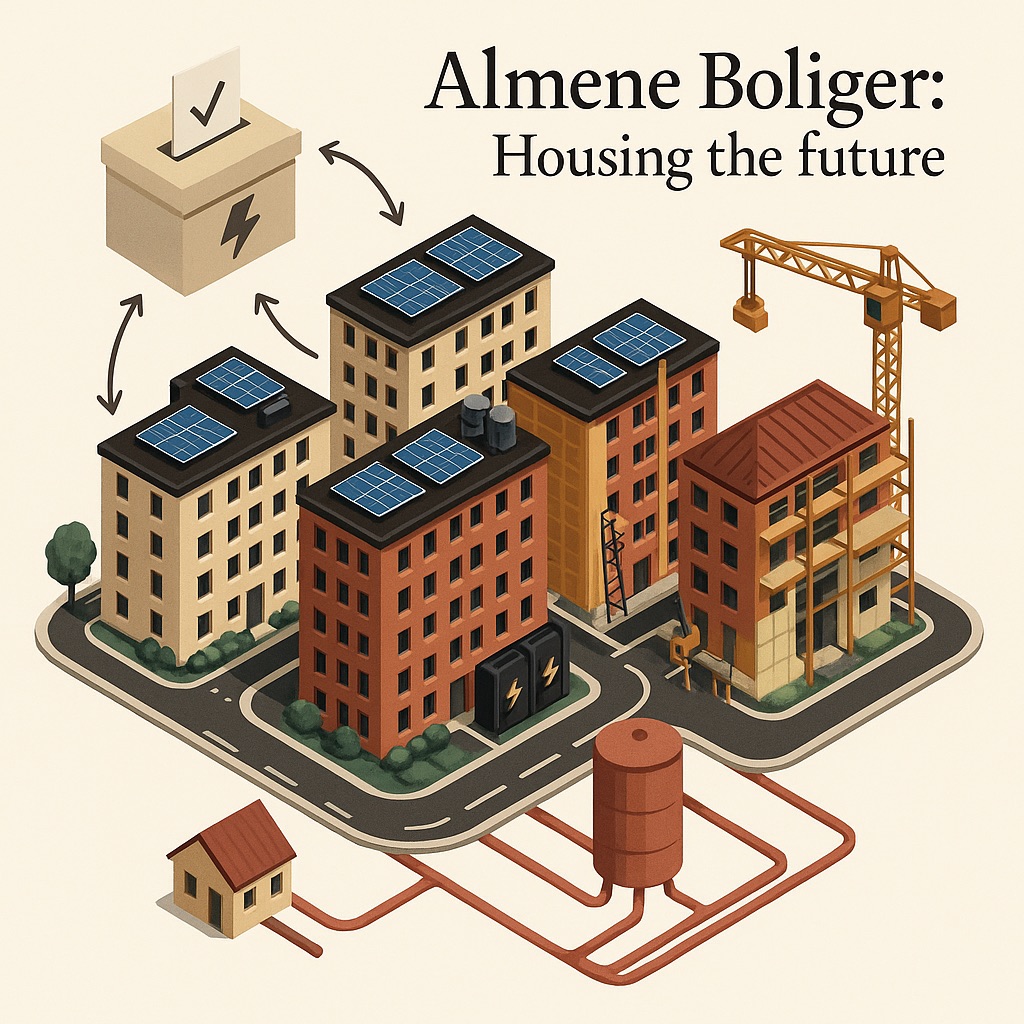
Created by Edgar Sarmulis with the use of A.I.
CHALLENGES
The increasing commodification of non-profit rental housing through policies such as the sales scheme of the mid-2000s, the 2018 ‘Parallel Society Law’, and flexible letting rules that reduce access for vulnerable groups. These measures complicate the role of non-profit housing associations (NPHAs) in providing equitable and secure housing. Despite the success of Øbro95, scaling up similar tenant-led energy initiatives in less affluent areas faces financial, social and regulatory barriers.
INNOVATION
Social innovation and technology engagemetn.
Blocking factors
- Institutional: a relatively conservative interpretation of EU energy distribution legislation results in a regulatory framework that favours established energy providers over the development of local energy communities.
- Internal governance: the decentralised structure of tenant democracy slows down the decision-making processes for capital-intensive retrofitting projects, particularly for green renovations that are not explicitly mandated within Landsbyggefonden’s (National Building Fund) set of objectives, when funding is not guaranteed.
Facilitating factors
- Institutional: long-standing non-profit housing laws and EU directives supporting energy communities; favourable municipal zoning and permitting; and pilot grants from city climate budgets.
- Social/cultural factors and ownership structures: a strong tradition of tenant democracy; established routines for representative tenant democracy; engaged residents and a DIY culture; communal land and assets that simplify joint infrastructure.
IMPACTS
Community Impact
The Øbro95 initiative improves affordability and tenure security for tenants by reducing energy costs through revenue redistribution from excess energy sales. It fosters a just transition by combining sustainability with direct economic benefits for residents without increasing rents.
Policy Impact
The initiative highlights structural housing challenges, such as restrictive letting policies and the weakening influence of non-profit housing associations, which limit access for vulnerable groups and hinder advocacy for legislative reforms. It highlights the need for policy changes, including enabling energy sharing between buildings, to support the wider adoption of similar models.
UPSCALING
POTENTIAL
Upscaling the Øbro95 energy initiative is hindered by restrictive Danish regulations, including the 2023 ban on electricity sharing between non-contiguous buildings, which limits replication in other non-profit rental housing associations. Despite these barriers, the broader European social housing sector offers strong potential for adopting similar energy community models, as well as the tenant-financed housing maintenance model coordinated by Landsbyggefonden (National Building Fund). Unlocking this potential requires regulatory changes.
EXPLORE ALL
PREFIGURE’s ‘Prototypes of Change‘ showcase 16 innovative, real-life responses to energy-housing precarity in the form of social, political, and economic solutions across eight countries: Bulgaria, Denmark, Estonia, Germany, Greece, Spain, Sweden and the Netherlands.