

Housing acquisition through cooperation
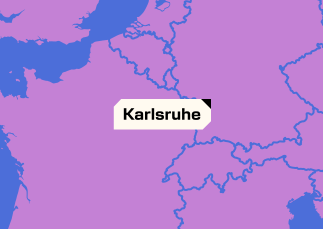
Housing acquisition through cooperation is a municipal policy instrument in the city of Karlsruhe that has existed since 2005. The Housing Security Unit of the Youth and Social Welfare Department is responsible for implementing a cooperative housing acquisition procedure within the associated housing agency. The process begins when a private owner offers the housing agency an apartment or a building containing several apartments. Next, the agency and the owner sign a 10-year occupancy agreement, whereby the agency provides the owner with a renovation subsidy and a rent guarantee in the event of rent defaults. Formerly homeless people initially receive a one-year usage agreement for the apartment from the Youth and Social Welfare Office. If this temporary arrangement is successful, the intention is for an independent tenancy agreement to be concluded between the owner and the tenant. Furthermore, the Social Welfare Office has hired social educators to support vulnerable residents and promote their independence as needed.


KEY
CHALLENGES
Social housing on municipal level, vulnerability, affordable housing

MAIN
IMPACT
Social and top-down innovation, social entrepreneurship

UPSCALING
POTENTIAL
Affordable housing and socio-pedagogical support for vulnerable persons

ACTORS
- Institutional: Municipality of Karlsruhe, Youth and Social Department of Karlsruhe, specialist unit, a housing agency, for securing housing, guides for homelessness persons, municipal social education workers.
- Market: company investor (IMMOBA Immobilien GmbH) and private owners.
- Civil society: tenants with various vulnerabilities (former homeless people, refugees, single mothers, people on low incomes) of the cooperative housing acquisition.

Created by Carolin Seiberlic with the use of A.I.
CHALLENGES
A key challenge is providing affordable housing for vulnerable groups. The municipal cooperative housing acquisition programme previously operated through a partnership with private homeowners, who offered one to three apartments to the municipality. Meanwhile, as part of the cooperative housing acquisition programme, vulnerable individuals are also being offered accommodation in two properties owned by a private investor. The ‘Para’ building, a former clinic, has 100 flats. Another property, the ‘Dörfle’, offers 150 flats to the housing market.
INNOVATION
Social and top-down innovation, social-entrepreneurship
Blocking factors
- Financial: the rents are still too high for some tenants.
- Social: inhabitants of the ‘Para’ building, which contains 100 flats, experience external stigmatisation from the neighbourhood. There have been conflicts between neighbours due to noise, vandalism and drug use.
Facilitating factors
- Institutional: The Youth and Social Welfare Department has incorporated cooperative housing acquisition into its governance structure by establishing a specialised department for securing housing. They have their own housing agency.
- Financial: funded by the municipal household.
IMPACTS
Community Impact
The number of social housing apartments with a price and occupancy agreement has declined in Karlsruhe since 2010, falling from 5362 to 3871. With the support of the Housing Acquisition through Cooperation programme, the number of affordable apartments in Karlsruhe has increased significantly. In 2024, a total of 1391 apartments were part of the programme. Thus, the continuous decline in the number of social housing units was thus at least contrasted by a countertrend. Nevertheless, there is still a shortage of 100 social housing units in Karlsruhe.
Policy Impact
- It would make more sense to extending the usage agreement between the municipality and tenants to a case-specific timeframe. This would enable the city to stay informed about the development of rental prices for the apartments. Additionally, fixed rental prices for the apartments should be agreed upon between the housing agency, private homeowners and company investors.
- It is necessary to hire additional specialists to take care of the energy modernisation of the apartments as part of the programme. In the event of energy modernisation measures, such as replacing windows, improving insulation or replacing the heating infrastructure with renewable energy sources, rent neutrality must always be ensured.
- Buildings with 100 or more residential units should not be occupied exclusively by vulnerable people. Smaller units in a building should be rented to vulnerable people through cooperative housing acquisition. Mixed usages of space, in addition to housing, could transform the space into a more liveable place.
UPSCALING
POTENTIAL
The cooperative housing acquisition policy instrument could be used as an example by other municipalities seeking to control affordable housing prices. Furthermore, it can facilitate the development of trusting relations between homeowners and the housing agency. Of particular relevance is the potential to secure an affordable housing segment in the local housing market.
EXPLORE ALL
PREFIGURE’s ‘Prototypes of Change‘ showcase 16 innovative, real-life responses to energy-housing precarity in the form of social, political, and economic solutions across eight countries: Bulgaria, Denmark, Estonia, Germany, Greece, Spain, Sweden and the Netherlands.