

CODE Housing Microloans
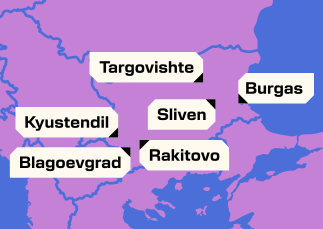
The Community Support Programme (CODE HOUSING) aims to provide economically vulnerable families with access to affordable housing improvements. This initiative is funded by Habitat for Humanity International’s Global Mission Fund and the Medicor Foundation. Operating across six Bulgarian cities (Burgas, Blagoevgrad, Kyustendil, Rakitovo, Sliven and Targovishte), the programme provides microfinance solutions for essential housing upgrades and delivers workshops. It also finances small-scale local initiatives designed to strengthen community cohesion and support sustainable development.


KEY
CHALLENGES
Energy poverty, financial exclusion of vulnerable households

MAIN
IMPACT
Microloans, workshops, community-managed funds

UPSCALING
POTENTIAL
National & EU scaling for energy updates

ACTORS
Initiators
- NGOs / research institutes: NGOs with strong community links; Habitat for Humanity Bulgaria, funded by HFH International and the Medicor Foundations
Current actors
- Citizen groups / communities: beneficiaries and community leaders in six cities.
- Institutional: Habitat for Humanity Bulgaria.
- Market: construction suppliers, energy consultants and technical experts.
- NGOs / research institutes: local NGOs managing local housing funds.
Beneficiaries
Low-income homeowners or tenants, and economically vulnerable groups.
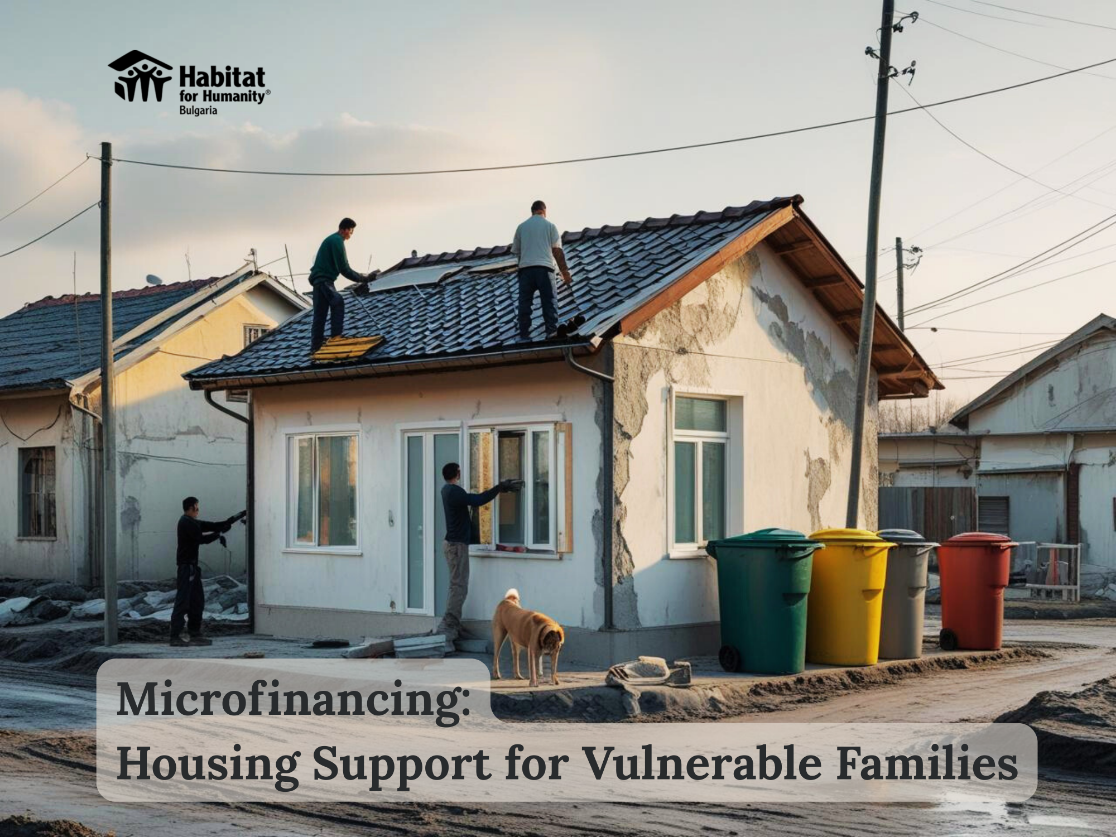
Created by the CSD team with the use of A.I.
CHALLENGES
High levels of energy poverty among vulnerable households, particularly in rural and peri-urban areas, are driven by poor building insulation, outdated heating systems and limited access to affordable renovation options. Structural financial exclusion prevents low-income families from benefiting from existing housing support schemes or accessing credit for essential energy upgrades.
INNOVATION
The prototype integrates interest-free microloans, energy efficiency workshops and community-managed project funds to empower low-income households to make basic home upgrades. This model fosters local ownership and community resilience.
Blocking factors
- Financial: the sustainability of the interest-free loan model relies on continuous external funding, with limited long-term national support.
- Institutional: the prototype lacks alignment with national policies, which limits institutional support and scalability.
Facilitating factors
At the national level, the organisation benefits from a supportive legal environment and funding from Habitat for Humanity International and the Medicor Foundation.
Locally, tenant participation and accessible microloans are important, as is strong community trust in NGOs and culturally sensitive engagement. Ownership of land and infrastructure is either private or municipal.
IMPACTS
Community Impact
Enabled 222 families to improve their homes and reduce their energy costs through microloans and workshops, and fostered local cohesion via community mini-projects
Policy Impact
Demonstrated the viability of micro-scale financial mechanisms for energy and housing upgrades in low-income, marginalised groups.
UPSCALING
POTENTIAL
The prototype has potential for scaling up both nationally and across Europe. This could provide greater benefits to low-income populations, improve energy efficiency, and promote sustainable community development across various regions.
EXPLORE ALL
PREFIGURE’s ‘Prototypes of Change‘ showcase 16 innovative, real-life responses to energy-housing precarity in the form of social, political, and economic solutions across eight countries: Bulgaria, Denmark, Estonia, Germany, Greece, Spain, Sweden and the Netherlands.