

One Stop Shop Energy Centres
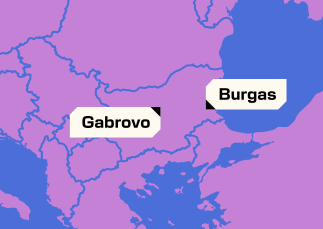
One Stop Shop Energy consolidates information, expert advice and financial assistance relating to energy. By bringing all these elements together, One Stop Shop Energy Centres (OSS) simplify what is often a complex and resource-intensive process, ensuring that energy-efficient solutions are achievable, accessible and sustainable. They streamline renovation by reducing administrative burdens and offering expert guidance on the regulatory, technical and financial aspects of energy efficiency projects.


KEY
CHALLENGES
Housing inequality, poor access to energy advices

MAIN
IMPACT
Institutional hubs integrating technical, financial, admin support

UPSCALING
POTENTIAL
National embedding in renovation plans & Social Climate Fund

ACTORS
Initiators
- Institutional: Municipality of Gabrovo and Municipality of Burgas, introduced under the Bulgarian Recovery and Resilience Plan.
Current actors
- Citizen groups / communities: energy community
- Institutional: Municipality of Gabrovo and Municipality of Burgas
- NGOs / research institutes: applicable both for Gabrovo and Burgas
Beneficiaries
Citizen, particularly low-income and those lacking the know-how for accessing information and technical expertise.
Created by the CSD team with the use of A.I.
CHALLENGES
Structural housing ineqaulity, poor access to information on energy efficiency and energy transition.
INNOVATION
Institutional innovation in the form of local one-stop-shop energy centres integrates technical, financial and administrative support into a single service. This makes assistance that was previously hard to access readily available, especially for low-income households.
Blocking factors
- Financial: provides technical support, but insufficient financing hinders deep renovations and support for energy-poor households.
- Institutional: complex administrative procedures within the centres’ own operational structures slow implementation and limit their ability to respond to local needs.
Facilitating factors
- Central support from the national government includes legal backing, EU and state funding, and clear energy poverty definitions.
- Widespread home ownership and proven renovation technology facilitate rollout.
- Locally trusted actors (in municipalities) lead OSS’s work, offering services, partnerships and grants that help more people to join.
IMPACTS
Community Impact
- Enhances local energy literacy.
- It empowers vulnerable households through personalised advice and community workshops in Gabrovo and Burgas.
Policy Impact
The localised solution works in harmony with central funding due to local embeddedness and trust networks. It has influenced national policy by being integrated into the RRP (C4.R5). Gabrovo’s model demonstrates a viable path for energy communities in liberalised electricity markets.
UPSCALING
POTENTIAL
Embedding OSS in national renovation and climate plans could help to secure national literacy in energy transitions through training programmes and technical partnerships. However, scaling up requires stable national funding.
EXPLORE ALL
PREFIGURE’s ‘Prototypes of Change‘ showcase 16 innovative, real-life responses to energy-housing precarity in the form of social, political, and economic solutions across eight countries: Bulgaria, Denmark, Estonia, Germany, Greece, Spain, Sweden and the Netherlands.