

Mustamäe
Mustamäe is Tallinn’s first neighbourhood-based renovation project, showcasing inclusive and integrated energy retrofitting activities across multiple buildings. Adhering to the principles of inclusiveness, beauty and sustainability set out by the European New Bauhaus, the project involves various homeowners’ associations. The project’s main challenges include enhancing energy efficiency, improving housing and environmental quality, and ensuring that the needs of residents are considered inclusively. The project links housing renovation, energy transition, and social inclusion, introducing policy and governance innovations to make retrofitting more inclusive, coordinated, and climate-resilient.


KEY
CHALLENGES
Need for coordinated
renovation model;
stakeholder misalignment

MAIN
IMPACT
Neighbourhood-based
retrofitting with inclusivity and design principles

UPSCALING
POTENTIAL
Replicable across Estonia’s
housing stock

ACTORS
Initiators
- Citizen groups / communities: apartment owners’ associations.
- Institutional: Tallinn University of Technology (TalTech) and the City of Tallinn.
Current actors
- Citizen groups / communities: housing associations; the Estonian Union of Co-operative Housing Associations.
- Institutional: Strategic Planning Department of the City of Tallinn; TalTech (technological solutions and data collection)
- Market: landscape architecture office Verte (designs public spaces); Think Softer (contributes to the renewal of courtyards); YOKO OMA OÜ (compiling a handbook).
- NGOs/ Research Institutes: NGO Elav Tänav (community engagement and co-creation).
Beneficiaries
- Residents of the prototype buildings, whose living conditions will improve significantly as a result of retrofitting.
- Apartment owners, whose property value will increase as a result of retrofitting.
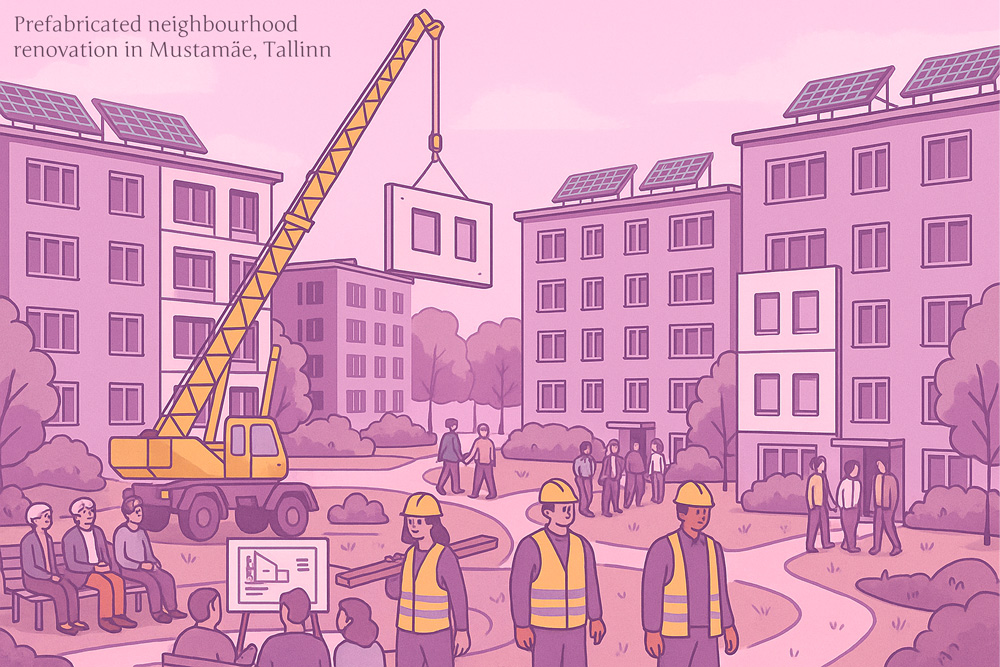
Created by Kirils Gončarovs with the use of A.I.
CHALLENGES
Developing a viable model through which the municipality, in collaboration with residents and national-level actors, could play a more active and structured role in the housing retrofitting process.
INNOVATION
Bringing together diverse stakeholders (residents, homeowners’ associations, the housing management company, the city government, national authorities and the private sector) to co-design neighbourhood-based renovation approaches that address energy efficiency, physical infrastructure, social cohesion, inclusivity and long-term well-being.
Blocking factors
- Financial: certain activities as part of the reconstruction are not funded by grants (e.g. lifts).
- Internal organisation: a lack of coordination among different stakeholders, including between the municipality’s own departments.
Facilitating factors
- Financial: local governments, such as Tallinn, fund public space upgrades on land owned by the municipality.
- Institutional: Estonia supports renovations through legal frameworks, grants and coordination by EIS and EKYL.
- Social/technical: prefabricated technology and active homeowners’ associations enable efficient implementation.
IMPACTS
Community Impact
To address the lack of people’s engagement, this project will test different methods of involvement and develop a manual detailing ways to involve residents in the renovation process.
Policy Impact
The process of transferring municipal land directly around buildings should be simplified to enable homeowner associations to carry out renovation solutions customised for each building.
UPSCALING
POTENTIAL
The Mustamäe prototype is designed to be replicated across other buildings in Estonia, helping to spark a wider movement of socially just and environmentally ambitious neighbourhood-level renovations.
EXPLORE ALL
PREFIGURE’s ‘Prototypes of Change‘ showcase 16 innovative, real-life responses to energy-housing precarity in the form of social, political, and economic solutions across eight countries: Bulgaria, Denmark, Estonia, Germany, Greece, Spain, Sweden and the Netherlands.