

Thermo Bello
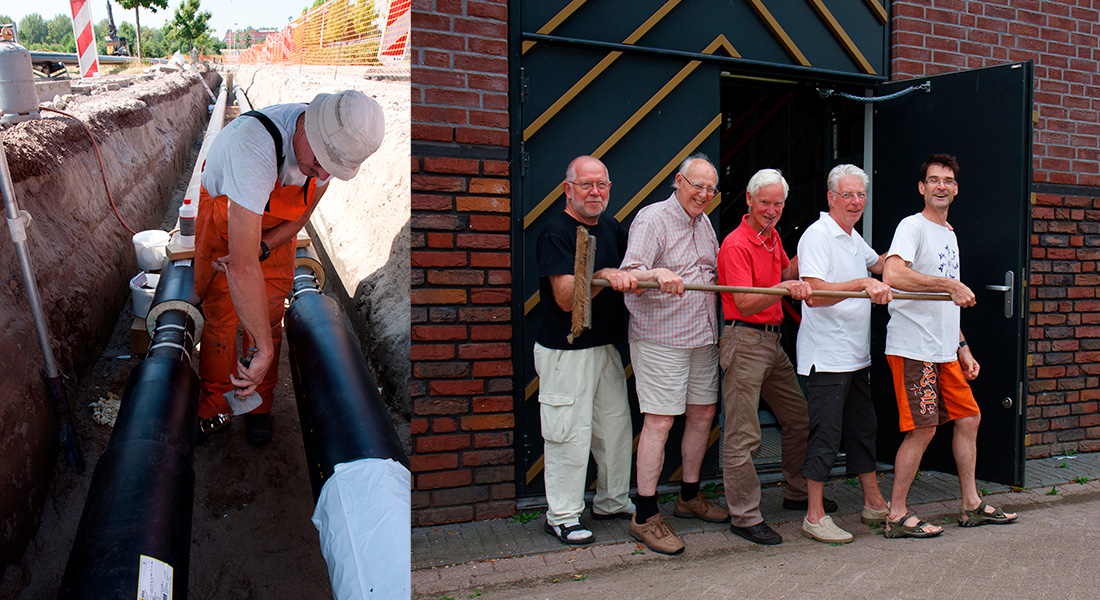
Thermo Bello is a community-owned district heating network in the EVA-Lanxmeer eco-village which has been operational since 2008. It supplies over 200 homes, a school, workspaces and shops with heat generated from residual heat sources provided by a local drinking water company. Its fully self-maintained system is operated daily by a small team of six and exemplifies sustainable, small-scale, cooperative energy solutions. It serves as a national model for neighbourhood-based heat networks.


KEY
CHALLENGES
High costs; concentration of technical knowledge in few hands

MAIN
IMPACT
lower energy costs; exemplary community practice

UPSCALING
POTENTIAL
depends from drinking water production capacity

ACTORS
Initiators
- Citizen groups/communities: the neighbourhood founded the energy coooperative to take over the existing heat network in 2008.
Current actors
- Citizen groups/communities: residents of the neighbourhood.
Beneficiaries
Residents of the EVA-Lanxmeer neighbourhood.
Credits: Huub van Beurden
CHALLENGES
High investment costs in electricity infrastructure are hindering Thermo Bello’s expansion. Although the cooperative is run by a few key specialised volunteers, this concentration of technical knowledge could lead to continuity gaps if maintenance demands increase or if volunteers are no longer able to continue their work.
INNOVATION
By establishing a cooperative, the neighbourhood took responsibility for maintaining and distributing heat to its local district network. Collective ownership and self-maintenance have been crucial in enabling them to maintain the high sustainability and autonomy standards they desire as an eco-village.
Blocking factors
- Financial: initially, it was difficult to obtain the necessary funding to take over the network. However, through the private investment of the residents, the infrastructure was purchased.
- Institutional: Thermo Bello is one of the few operational district heating energy cooperatives in the Netherlands, and legislation often fails to recognise this.
Facilitating factors
- Institutional: at the time of creation, the municipality was supportive and the existing energy company gave the new cooperative time to organise the takeover of the network.
- Internal: The energy cooperative was created by the residents of the eco-village, for whom self-sufficiency and autonomy are key values.
IMPACTS
Community Impact
Through self-organisation and self-maintenance, the residents were able to maintain their highly sustainable district heating network while keeping energy costs low.
Policy Impact
Thermo Bello is an example of affordable, sustainable, community-oriented living with self-sufficient energy provision. The project is also an active part of national platforms such as EnergieSamen, which influence energy and cooperative policy-making.
UPSCALING
POTENTIAL
The project can expand as they have sufficient heat; however, the necessary electrical infrastructure to enable this is costly. As the project relies on the drinking water production capacity of Vitens, it cannot grow beyond this.
EXPLORE ALL
PREFIGURE’s ‘Prototypes of Change‘ showcase 16 innovative, real-life responses to energy-housing precarity in the form of social, political, and economic solutions across eight countries: Bulgaria, Denmark, Estonia, Germany, Greece, Spain, Sweden and the Netherlands.